


There Is More Than One Type of Hip Replacement
If your doctor has mentioned hip replacement as a possibility, you may be picturing a single, standard procedure. In reality, there are different types of hip replacement, and the right one for you depends on how much of the joint is damaged, your overall health, and what your surgeon recommends based on your specific anatomy.
Understanding these options ahead of time can help you feel more prepared for that conversation. This article breaks down the key differences between partial and total hip replacement, explains the surgical approaches your surgeon may use to access the joint, and covers what influences the recommendation you receive.
Total Hip Replacement vs. Partial Hip Replacement
The first distinction most patients encounter is whether they need a total or partial replacement. These are two different procedures designed for different levels of joint damage.
Total Hip Replacement
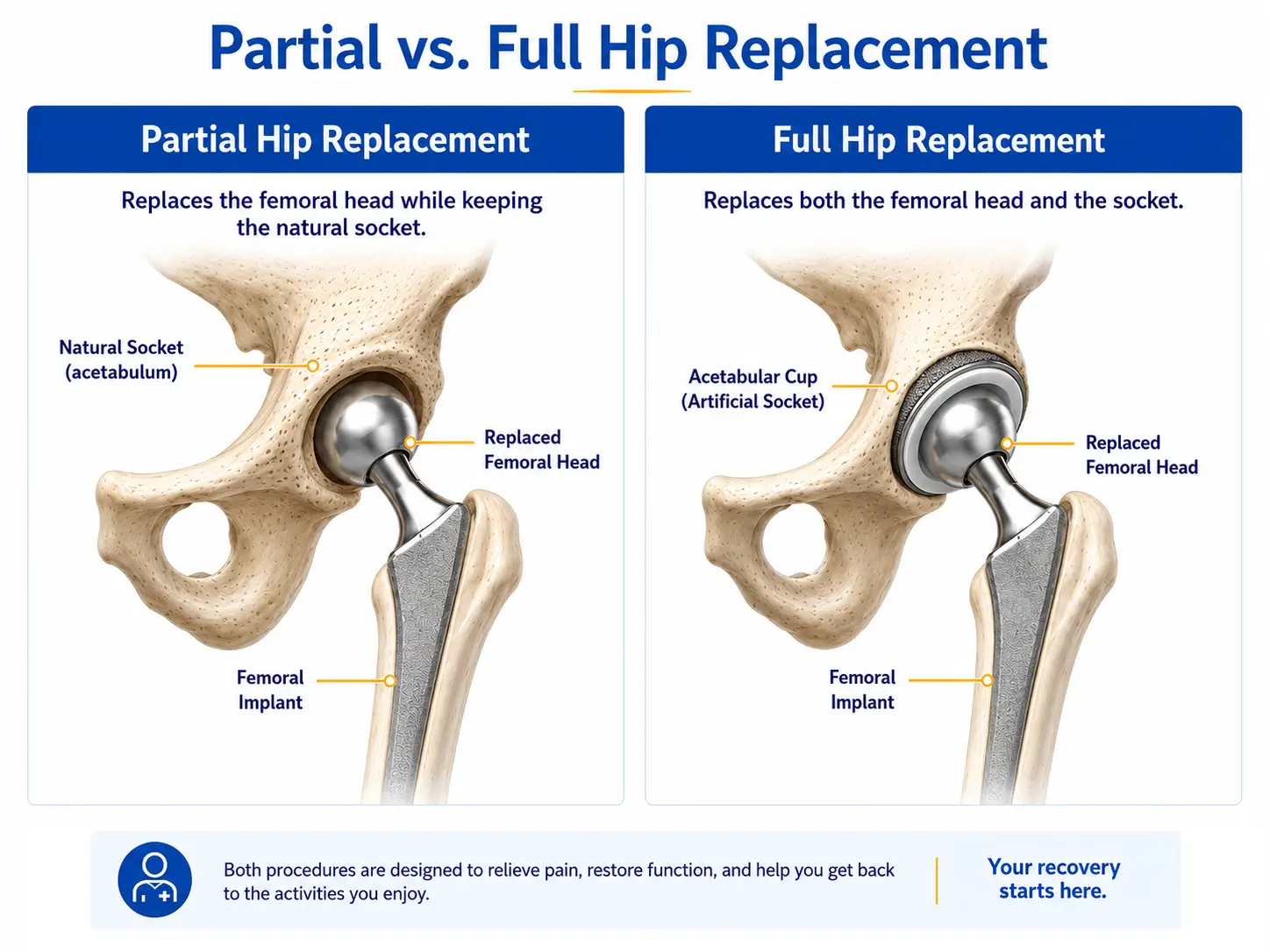
In a total hip replacement (also called total hip arthroplasty), the surgeon removes both the damaged ball (femoral head) and the worn socket (acetabulum) and replaces them with prosthetic components. The new ball is typically made of metal or ceramic, and the socket is lined with a durable surface designed for smooth, low-friction movement.
This is the most common type of hip replacement and is typically recommended when arthritis, degeneration, or injury has affected the entire joint. It is well-suited for patients with widespread cartilage loss, bone-on-bone contact, or significant stiffness that limits everyday movement.
Partial Hip Replacement
A partial hip replacement (hemiarthroplasty) replaces only the femoral head, leaving the natural socket intact. This procedure is less common for arthritis-related cases and is more often used for certain types of hip fractures, particularly in older patients where the socket is still healthy, but the ball of the joint has been damaged by a break.
Because the socket is preserved, the procedure is typically shorter and involves less bone removal. However, it is only appropriate when one side of the joint is the clear source of the problem.
At Andrews Institute, our surgeons specialize in total hip replacement. Partial hip replacement is typically performed in hospital settings for acute fractures and is not a procedure offered at our facility. If your provider has recommended total hip replacement, our team can help you understand your options and what to expect.
The Key Difference
Total replacement addresses damage throughout the joint. Partial replacement addresses damage on one side only. Your imaging and diagnosis will determine which approach makes sense for your situation.
At Andrews Institute, our surgeons perform total hip replacement in an outpatient setting, using advanced techniques to support same-day recovery.
Surgical Approaches: How the Surgeon Accesses the Joint
Once your surgeon recommends total or partial hip replacement, the next step is deciding how to access the joint. This is called the surgical approach, and it refers to the direction and path the surgeon takes to reach the hip. Different approaches involve different incision placements and affect which muscles or tissues are moved during surgery.
Understanding these terms ahead of time can help you follow your surgeon’s recommendation and ask better questions during your consultation. Your surgeon will select the approach based on their specialized training, the surgical setting, and what they’ve found works best for patients with your specific needs.
Anterior Hip Replacement
The anterior approach accesses the hip joint from the front of the body. Rather than cutting through major muscle groups, the surgeon works between them to reach the joint. This technique has become increasingly popular because it may allow for a smaller incision, less muscle disruption, and fewer post-operative restrictions on movement (such as crossing the legs or bending past 90 degrees).
Many patients who undergo anterior hip replacement report feeling stable on their feet sooner after surgery. However, not every patient is a candidate for this approach. Body type, the complexity of the joint damage, and the surgeon’s assessment of your anatomy all factor into whether it is the best option.
Posterior Hip Replacement
The posterior approach reaches the hip from the back of the body. The surgeon separates muscles behind the hip to access and replace the joint. It is one of the more commonly performed techniques and has a long track record in orthopaedic surgery.
Because this approach involves detaching soft tissue that helps stabilize the joint, patients are typically given temporary movement precautions after surgery (like avoiding certain positions) while those tissues heal. Some surgeons use this approach for revision surgeries or more complex cases where greater visibility of the joint is needed.
Lateral (Direct Superior) Approach
Some surgeons use a lateral or direct superior approach, accessing the hip from the side or top. These techniques aim to balance muscle preservation with surgical visibility. They are less commonly discussed than anterior and posterior approaches, but may be preferred depending on the patient’s anatomy and the specific demands of the case.
Which Approach Is Best?
Research shows that long-term outcomes, including pain relief, implant longevity, and return to activity, are similar across approaches when performed by experienced surgeons. The differences are mostly in early recovery, such as post-operative precautions and how quickly patients regain mobility.
In practice, most orthopaedic surgeons specialize in one primary approach. This is because surgical technique improves with focused repetition, and each approach requires specific training, positioning, and instrumentation. A surgeon who has performed thousands of hip replacements using one approach will typically deliver the best outcomes through that technique. The setting also plays a role. Outpatient surgery centers, for example, may favor approaches that support same-day discharge and fewer post-operative restrictions.
When you meet with your surgeon, ask which approach they use and why it works well for patients like you. A confident surgeon will explain their reasoning, walk you through what to expect, and help you understand how their experience and your specific needs come together in the surgical plan.
Can Hip Replacement Be Done With Robotic Assistance?
Yes. Some hip replacement procedures are now performed with the assistance of robotic technology. Systems like Mako SmartRobotics use a CT scan of your hip to build a 3D model, which helps the surgeon create a precise, personalized surgical plan before the procedure begins.
During surgery, the robotic arm provides guided boundaries so the surgeon can place the implant with a high degree of accuracy. The surgeon remains in full control throughout. Robotic-assisted hip replacement can be performed using either an anterior or posterior approach, depending on the surgeon’s preference and the patient’s needs.
Not every patient requires robotic-assisted surgery, and not every surgeon uses this technology. But for eligible patients, it offers an additional layer of precision in implant positioning. You can learn more about Mako robotic-assisted surgery and how it works at Andrews Institute.
What Determines Which Type of Hip Replacement You Need?
Your surgeon will recommend a specific type of hip replacement and surgical approach based on several factors. No two patients present the same way, which is why a thorough evaluation matters more than general advice.
Factors that influence the recommendation:
- Diagnosis: Osteoarthritis, rheumatoid arthritis, avascular necrosis, hip dysplasia, and fractures each present differently and may require different solutions.
- Extent of damage: Imaging reveals whether both sides of the joint are affected (pointing toward total replacement) or just one (which may allow partial replacement).
- Bone quality and anatomy: The shape of your pelvis, bone density, and any prior surgeries can make certain approaches more suitable than others.
- Activity goals: A patient who wants to return to golf or hiking may be evaluated differently than a patient focused on pain-free walking.
- Health profile: Age, weight, cardiovascular health, and other medical conditions all factor into surgical planning and approach selection.
This is why a consultation with an orthopaedic surgeon is essential. They can review your imaging, assess your joint, and explain which option fits your specific situation.
What to Expect from Recovery
Recovery from hip replacement varies by patient, but most people notice a significant reduction in pain within the first few weeks. Physical therapy begins quickly (often the same day or the day after surgery) to restore mobility and build strength around the new joint.
General recovery milestones for total hip replacement:
- First 1 to 2 weeks: Walking with a walker or cane, managing swelling, and beginning gentle exercises at home.
- Weeks 2 to 6: Increasing walking distance, transitioning off assistive devices, and progressing through physical therapy.
- Months 2 to 4: Returning to most daily activities, driving (once cleared by your surgeon), and rebuilding endurance.
- 6 months and beyond: Continued strength gains and return to recreational activities like swimming, cycling, or golf.
Patients who have their procedure in an outpatient setting often go home the same day, which allows them to begin recovery in a familiar, comfortable environment. This is especially common for patients in good overall health with a strong support system at home. For a full overview of the process, visit our surgery day guide.
Questions to Ask Your Surgeon
If hip replacement is on the table, coming prepared with questions can help you feel more confident about the path forward. Consider asking:
- Is total hip replacement the right option for my condition?
- Which surgical approach do you recommend for my case?
- Is robotic-assisted surgery an option for me?
- Can my procedure be done on an outpatient basis?
- What does my recovery timeline look like based on my health and goals?
- What are the risks specific to my situation?
A good surgeon will welcome these questions and take time to explain their reasoning. The right type of hip replacement is not just about the joint; it is about the whole picture of who you are and what you need.
Find a Hip Replacement Specialist
When hip pain limits your ability to move, sleep, or enjoy daily life, and conservative treatments are no longer providing relief, it may be time to explore hip replacement with a specialist who can explain your options clearly.
At Andrews Institute Ambulatory Surgery Center in Gulf Breeze, FL, our orthopaedic hip surgeons bring fellowship-level training, advanced techniques, and a personalized approach to every patient. Whether your path leads to a total replacement, a specific surgical approach, or robotic-assisted care, our team is here to help you make an informed decision and support your recovery from consultation through rehabilitation.